Palestine – Promised To Whom?

At the start of 1917, Arthur Zimmerman, the head of Germany’s Foreign Office, sent a secret coded telegram to the German ambassador in Mexico. It had instructions for the ambassador to meet the President of Mexico at once, and convince him to join the Central Forces in the on-going World War. It was a desperate attempt to ensure that the US does not enter the War, and if it does, Mexico should use its convenient location to try and neutralise the US efforts and keep it away from Europe. The offer promised Mexico that it would gain back its lost territories of Texas, Arizona, and New Mexico as spoils of war.

On the other hand, the Allied Forces led by the British and French were keen to have US join them. With the unending trench warfare, a strong ally like the US could help them cast a few damaging blows. Russia was already proving to be weak, both on the domestic front due to a strong threat to the monarchy by the Bolsheviks, and the fizzling out of the Eastern European front of the war with improper supplies and re-enforcements.

With many falling pieces, the British became desperate. They decoded the Zimmerman Telegram and shared it with the US, persuading them to join the war. It, however, did not prove to be forceful.

To save themselves and ensure that the sun does not set on their empire, they made conflicting promises to several parties. All these promises had one end in sight – their own victory. Seeking victory is admirable, but when it is based on promises made to allies, knowing fully well that they cannot be delivered, it is the ugliest form of realpolitik.

First, the British aimed at ending the Ottoman rule over Anatolia. As Turkey joined the Central Forces, defeating it became important to ensure that the Bosporus Strait is controlled to keep up the shipping lines with Russia. But to attack the Ottoman, the much revered Muslim power which ruled for over four centuries with the perception of being the ‘Caliphate of Islam’, would not be an easy task. Muslim nations and people across the world would heavily protest it, making the British a direct attacker of Islam. The fact that the Indian sub-continent saw the Khilafat Movement by Ali Brothers, joining hands with Gandhi proved these fears credible. They gained validation from Gandhi who went on to add the restoration of Hejaz to Muslim rule as one of the demands of the Non-Cooperation Movement of 1919. To damage this Turkish hegemony, a revolt had to be fomented from within.

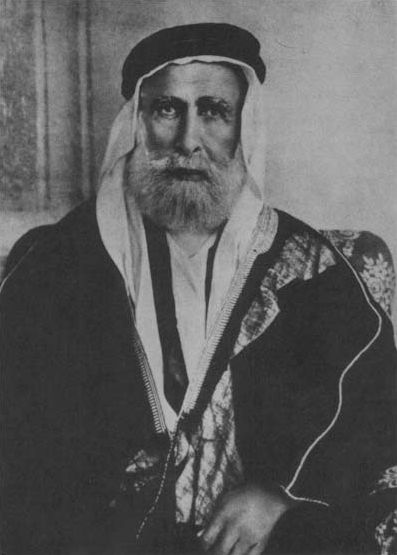
To this end, the British spotted Hussein ibn Ali, the Sharif of Mecca, and more importantly, a descendant of the Prophet and his Banu Hashim clan. In the year 1916, an elaborate series of ten letters were exchanged by Henry McMahon, the British High Commissioner to Egypt (and the same man famous for his McMahon Line that demarcated India and Tibet – now China). Hussein ibn Ali was encouraged to initiate a rebellion by the tribesmen of Hejaz against the Ottoman monarchy. Called the ‘Great Arab Revolt’, it aimed to push back the Turkish ‘foreign’ rule and replace it with the home-based Arab State. A promise was made to create a unified Arab State from Syria to Yemen. To ensure clarity, Hussein ibn Ali added ‘Palestine’ to this territory, which the British approved, believing it to be simply a re-statement of the obvious. It would take four years for the British to change their stance.

Hussein ibn Ali Al-Hashmi, the Sharif of Mecca, who would eventually be betrayed by the British and defeated by the now-ruling Ibn Saud family which supports Salafi thought, a passive sympathiser of Zionism and Israel.


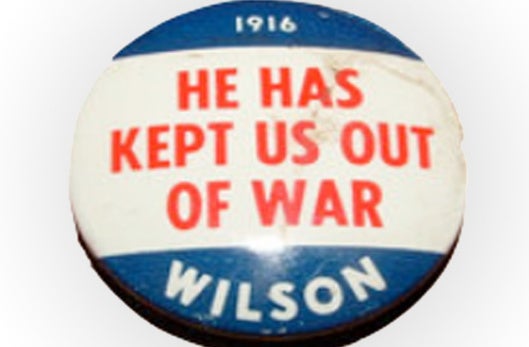
Second, the British would pull all strings required to drag the US into the war. The re-election of Woodrow Wilson as the President in 1916 made this task difficult. In one of the closest Presidential Elections of US, President Wilson managed to defeat his Republican opposition, Charles Hughes. California proved to be a decisive State, which Wilson won by a margin of mere three thousand votes. The entire campaign of Wilson was based on the fact that he kept the US out of the World War, something that looked like a triumph and ensured his election victory.

Badge from the Woodrow Wilson Presidential campaign of 1916.

Another badge which celebrates Wilson keeping US out of war.


However, the British desperation would make them explore, and exploit, the Jewish dream for the promised land. In the 1890s, a man named Theodor Herzl would go on to write a book titled ‘Der Judenstaat’ – The Jewish State. He then would deliver a powerful speech at the First Zionist Congress held in 1897 in Basel. He proposed a clear idea to achieve the Jewish State – a steady and gradual migration of Jews to Palestine. To ensure that Jews aren’t seen as hostile invaders, he recommended that they purchase farm land and houses, and strengthen the population. This, he timelined, to happen for about fifty years. Once a substantial population of Jews is mobilised, he called for an independent sovereign State to be founded – the State of Israel. While it seemed far-fetched at that time, Israel would surely be founded in just about fifty years, in 1948, adopting Herzl as the father of the new nation.

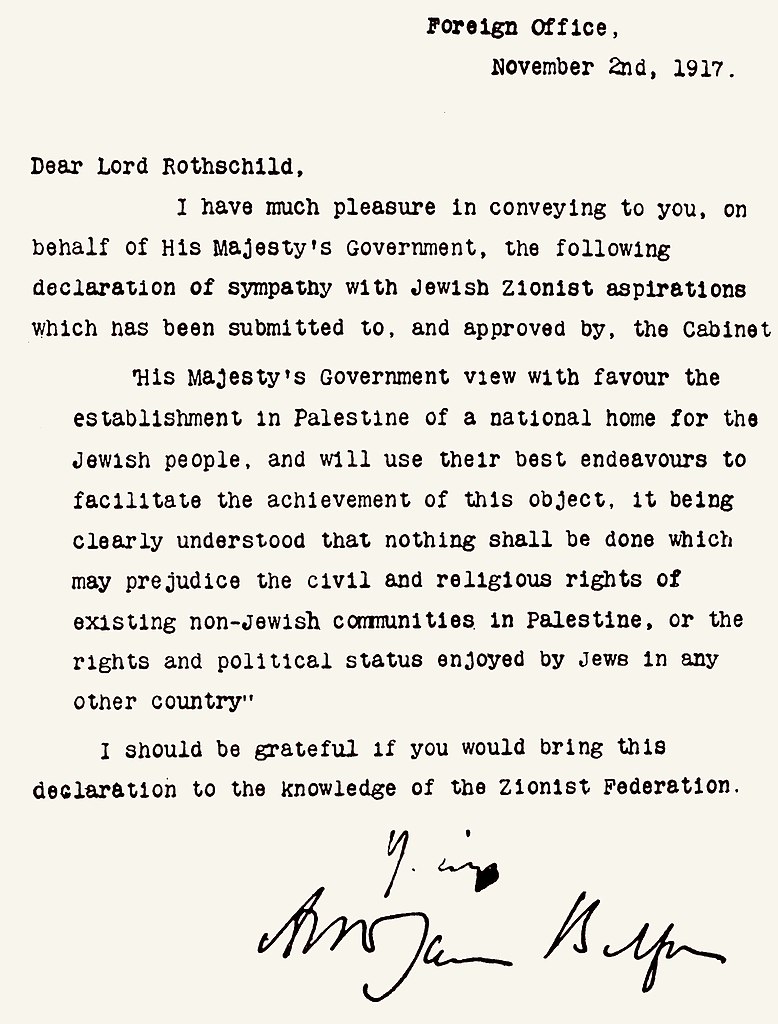
But the Zionist aspirations looked feeble during the World War. Until, of course, the British would use this for their ends. As the Jewish lobby in the US exerted strong influence over the Presidential policies, the British wanted the Jews to lobby for the US to enter the World War. In return, the British would promise – no points for guessing! – the promised land of Palestine. In a letter written by Arthur Balfour, the British Foreign Secretary, to Lord Rothschild, a leader of the British Jews, Palestine was proposed to be made the Jewish State that the Jews aspired to build. This worked, and within a month of President Wilson taking his oath, he declared war on the Central Forces.

Balfour Declaration (1917)


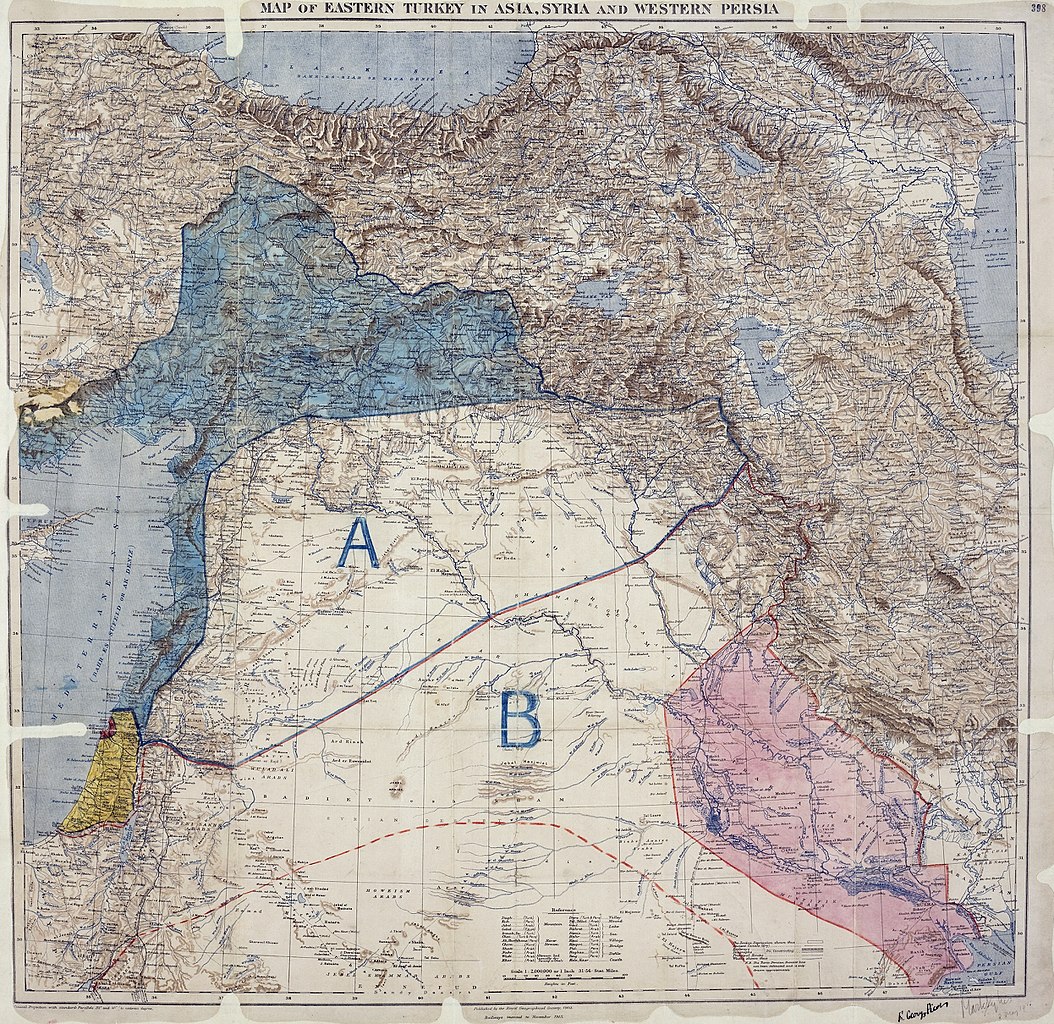
Third, the alliance of Britain, France, and Russia, involved some daydreaming. The Triple Entente, as they were called, would cut out the middle east between Britain and France. The Sykes-Picot Agreement would demarcate areas to be taken up as their own by these two countries. The British promised themselves that they would get Jordan, Southern Iraq, and – I need a drum roll here – Palestine!

The Demarcations by the Sykes-Picot Agreement (1916)


After the war, the British proved true to their own promise to themselves. Until ousted in 1948 by the birth of Israel, they governed Palestine as a Mandate under the League of Nations. Their hearts would change again as they find President Gamal Abdel Nasser of Egypt to be their new enemy as he nationalised the Suez Canal. They then join hands with Israel and invade Egypt, only to be humiliatingly subdued and defeated by Nasser.

The modern history of Palestine is, thus, riddled with conflicting promises. The British slyly withdrew when they could control the territory no more and had a final nail in the coffin as a super-power.

It is this Palestine, the land that was promised not once, but thrice – to the Arabs, the Jews, and the British themselves – that cries under the oppression and the growing settlements of Israel. A land where Moses, Jesus, and Muhammad (may peace be upon them all) walked, now witnesses the flow of blood. And the new Holocaust continues.

The Present Repeats

We’ve been here before. More than a year has passed since the pandemic, and yet the virus continues to destroy lives and families. In the last week, barring a few exceptions, every person I spoke to has either been infected with the virus or has a family member who suffers from it. We now have over Two Lac reported cases per day with no means to predict how bad this can get.

Tracking the virus numbers has become my not-so-favourite pastime. During the last three Trump months of November to January, I especially kept an eye on the US cases. I must admit that I found some glee in the increasing numbers. It felt like some poetic justice to the masses who confidently refuse to wear masks or maintain distance.

Over time, however, it dawned upon me that these numbers are not just mere numbers. They are a body count. And each number has a story behind it. A story of not just how they caught the virus, but how their happiness has been stolen away and replaced with misery. A story of their families struggling to make ends meet. A story of several lives disappearing without as much as a single person to pay respects at their burials, let alone conduct a funeral.

Like all disasters – both manmade or otherwise – the weakest fall first. Those who have access to healthcare and are able to afford it have suffered much lesser than those who do not. Even amongst those who have all material resources, the ones that lack bodily immunity have lesser chances to make it through.

The end is not near. Some talk about ‘herd immunity’, that once most people are infected with the virus and become immune to it, we no longer have to worry about it. But we’ve been wrong all along. The virus we face now isn’t the same as Measles, Polio, Mumps, or Chickenpox. It does not make one immune for the entirety of one’s remaining life. The immunity, at best, lasts six months. Hence, when done nothing, this virus may become a cyclical part of each of our lives, where one can be infected every six months, eventually succumbing to it when our body becomes weak enough to fail. The vaccines, even if efficacious, give no more than the same six months of immunity.

As a second-grade citizen in a third-world country, there is not much I can say or do. Our voice is redundant. One could fight, only if there was any hope. But there isn’t any. What we could not do at the bloody partition of ’47, we have successfully achieved now – to inculcate and internalise hatred for the political mobilisation of the majority. Let us not blame the politicians alone for they desire power through these means. Every person who has been communalised is responsible for what our country has become. These are not herds of sheep being led down blindly to their aspirations of some perennially elusive ‘development’. They are soldiers of new India who have actively chosen to feel powerful using their majority identity and find validation in the oppression of the minority. Place these very people in a country like the USA, and you will hear them speak the language of ‘equality, justice, and minority rights’.

I’ve always been proud to wave the Indian flag and sing the anthem the loudest. But I am beginning to feel that this isn’t the country I used to call home. Despite being fairly privileged, I have waves that hit my mind which make me feel like a refugee in my own country. The Covid narratives, which have spread as far as my village, has made those who’ve seen me all my life consider me to be a little different. Every other variable has been constant, but something has surely changed in how they behave. And it doesn’t require much thinking to know why.

Hope is too feeble. When there’s no power, there is also no responsibility. Doing nothing is, perhaps, the easiest thing to do. I shall continue to do nothing and be a witness of everything that unveils. However, with this healthcare crisis crushing us, I do pray that each of us have ease not just in life, but also in death.

Quiet Fortitude

Nothing. I have nothing to write. But I feel like writing something. Anything.

The pandemic has been tough for most. I cannot claim that it was tougher than it has been for many. I recognise that my privilege has come to my rescue to help with the recent struggles and lifestyle changes. When staying in the city became uneasy due to the apprehension of the virus touching, my parents and I could seek refuge from it in my village. I spent more time with my parents than I ever did in the last one decade. I chose to tend to the plants and kittens to stay sane. Internet, with a good mix of Netflix and Chess, helped me stay engaged.

However, I am afraid that I may not be as social a person as I used to be. For almost ten months, I barely met anyone of my age. And the next time I do, whenever that might be, I may stumble to have a decent interaction.

More importantly, I have felt quite alone. I still do. I’ve seen some ugliness in the people I trusted. From those I gave too much leeway to those who have been friends for a decade, it was disturbing to see their nasty side. I felt better to stay away from those who proved to be self-serving, and make efforts to push through on my own.

This made me appreciate and reaffirm my faith. That in all things dispensable and perishable, I am better off relying on Him, the eternal, to do what is just, fair, and kind. I am an incomplete person, and I humbly hope, that I always remain so.

While I pray for myself, here’s a little prayer I make for you, the kind stranger reading this blog:

.

زیر قاوسی قزح یوں انجمن آرائی ہو
پِھر نا لب پہ تا آباد شکوہ تنہائی ہو

Zer-e-qaus-e-qazah yun anjuman arai ho,
Phir na lab pe taa abad shikwa-e-tanhaaii ho.

Wish your life be spent in the abode of rainbows such
Never till the end of time, there be a complain of loneliness.

بکھرے حنا نخل اُس شب روز تیرے
باغ جناح کو بھی راشق زیباای ہو

Bikhre hina nakhl-e-aus shab-o-roz tere,
Bagh-e-jinaah ko bhi rashk-e-zebaaii ho.

Let Henna spread every day and night akin to pleasant fog
Even the gardens of heaven be envious of your life’s beauty.

نور مہتاب کرے پرنور آیناح زندگی
جسکے جلوے کی سوریا بھی تماشاای ہو

Noor-e-mahtaab kare purnoor aaina-e-zindagi,
Jiske jalwe ki surayya bhi tamaashaaii ho.

May the moonlight make the mirror of your life shine
And the galaxies too be a witness of such radiance.

Say Amen!

Navigating Law School: A Primer

The romanticisation of law schools that has happened over the last decade has made them an end in themselves, rather than simply being the means to an end you pursue. For most, making it to the top NLU would mean that they are guaranteed high-salary jobs, instant social mobility, and some glory. As in the case of, say Bitcoin, as the demand of an NLU seat increases, so does its perceived value.

It is only after making it to a law school that one realises that they are expected to work even more for five long years to achieve what they want. The competition that they faced during their CLAT prep days is now replaced with the competition from their batchmates. Everyone wants to win more moots, publish more papers, participate in debates, and do fancy internships in an effort to boost their CVs and stay a step ahead of others in the race. The strong insecurity generates anxiety when they see others doing something that they are not doing. You lose sleep, feel restless, and overall, drive yourself mad with the fear of losing out.

Take a pause. Breathe.

In the past two months, I have been asked the variations of same questions from several people starting their law school journeys. And I found it easier to write a post here than to reply to each individually. While I put down the pointers drawn out from my own experience at NALSAR, I must admit that I have barely lived these myself. In the hindsight, my law school life surely could have been better than it was. And hence, while you may take my advice for what it is worth, you should not take any lesson from my own law school life, for you can do much better!

Here is a list of seven pins one must keep in mind:

1. Grades. A lot of narratives tend to undermine the marks you score. While grades are not everything, they are something. When you apply for internships or jobs, your CGPA tends to stand out. There are always people who achieve a lot with a low CGPA, but do not mistake this exception for the rule. Good grades show that you were attentive in classes, did your readings responsibly, wrote your exams well, and perhaps, have good knowledge and clarity. Make sure you follow your classes and its assignments to write good exams, and strive to be in the top ten of your batch.

2. Moot Courts. This is where the overkill occurs. The glamour of standing at the podium in an elegant suit and firing away arguments is quite appealing. But it is important that you look beyond this façade. Moot courts are an excellent way of achieving conceptual clarity, confidence, and enhancing your skills. No other law school activity comes close. However, you must tread carefully. Three factors are important in choosing the competition:

a. Your teammates: Ensure that they aren’t your closest of friends. If they are, doubly ensure that your personal relationship isn’t hurt in all the bickering of who gets to do what.

b. The topic: It is not sensible to do an International Law or Taxation Law moot in the first or the second year. There’s time and tide for everything. I learnt this the hard way when I did a Tax Law moot in my second year and was clueless of the most basic concepts simply because we had not done Tax Law as a part of my course, which was to come in the third year. Start with a Tort, Criminal Law, Contract, or even Constitutional Law moot, and you can get into complicated fields in the latter half of your law school.

c. Depth of understanding: I have, from time to time, been invited to judge moot court competitions. And I found it incredibly easy to see through the speakers and their memorials for how hollow they were. In a recent one, when the facts had similarities to Rohingya immigration, I was surprised to see that the teams were not aware of the Tibetan refugees in India. After this, I did not have any more questions for this team. Hence, it is important that you understand not only the law on point, but also the history, the developments, and several allied events around it.

3. Debates and MUNs. A lot of you who may have done debating in schools might get too excited about these. While they are a lot of fun and give you an immediate sense of validation for making that one cleverly crafted argument, they are not as important in the larger picture. If you are interested, you may do plenty of them. But ensure that they do not become everything for you. If you are not interested, you may give this a convenient pass. However, if you choose to debate, make sure that you read up a lot and gain in-depth knowledge of broad-ranging issues. It is of no use to go faff with rhetoric, how much ever ‘cool’ they may make you appear.

4. Research and Publication. A good amount of research and writing is done as a part of your projects. This is an essential skill to be had in a lawyer. If you like doing it, you must pursue this to a good end. Again, do not overdo it. Writing one good, well-researched, original paper every semester is good enough. You may send this to a journal or a conference. But do not compromise on what is indispensable – an original piece with well-nuanced arguments, not gibberish to meet the word limit.

Even if you are not too keen about this, I would still urge you to give it a try. It takes a lot of effort and energy in writing a paper, and you come off better and more knowledgeable with it.

5. Extra-Curriculars. College is when you have more than sufficient time to do ten other things you want to do. Play a sport, sport a play, or join any clubs that may interest you. From volunteering at Teach for India to running ten kilometres a day, you may choose any activity that keeps you engaged. Reading clubs, poetry recitals, art therapy sessions, etc. are few of your options. From some experience, I vouch that a launching a good start-up is something you could do, as long as it doesn’t take up all your time.

6. Internships. They say that you learn more at internships than in classes. To a large extent, they are right. Internships help you understand how industry works, familiarise yourself with the atmosphere at the workplace, and gain some people skills. Apply to organisations which give you good work. It is too common to see people running to get an internship at a place which looks good on their CV. The utility of this is short-lived. Get a place that grills you to work and teaches you a thing of two.

In your first and the second year, you may start with NGOs (such as HRLN, PUCL, etc.) or policy places (such as CPR, CLPR, CIS, etc.), or trial court Advocates or Judges. Only in your third year should you apply to Law Firms, Corporates, and Advocates at the High Court and Supreme Court. Try following this pattern, for if you jump to Law Firms in the very first year, you may gain little utility from that.

7. Learn. I should have placed this at number one, because nothing is as important as learning. Cultivate a good habit of reading. Read newspapers, long-form articles in magazines, and books on what you like. Invest a couple of hours every day in this. Use your library to the full extent. This does not show immediate results. It is a slow process, but over-time, you will realise that you are more educated and knowledgeable, rather than being simply a literate with a law degree.

A mandatory post-script here is that these pointers are fluid. If you like more of one thing, do that more. It is not essential that you do all, nor is it advisable that you do none. And while you are at it, make friends. Make good friends. Friends that will last a lifetime, and don’t just gossip.

Ultimately, success is not found only in winning a Jessup or a MukMem. It is especially not success to win these at the cost of your happiness and mental peace. If something does not work out for you, you may leave. A good long-term satisfaction and happiness is an end that is worth chasing over anything and everything.

All the very best!

#1 – Izteraab / इज़्तिराब / اضطراب

Zakhm bharte hain alfaaz ki ambaaroN mein,
Koi mehfil kahaaN in taarik dayaaroN mein.

زخم بھرتے ہیں الفاظ کی انباروں میں
کوئی محفل کہاں ان تارک دیاروں میں۔

ज़ख्म भरते हैं अलफ़ाज़ की अम्बारों में,
कोई महफ़िल कहाँ इन तारिक दयारों में.

Ho tera noor jalwa-numa in baharoN mein,
Chhup jaaye woh mah bhi kisi taaroN mein.

ہو تیرا نور جلوہ نما ان بہاروں میں
چھپ جائے وہ ماہ بھی کسی تاروں میں۔

हो तेरा नूर जलवा-नुमा इन बहारों में,
छुप जाए वह माह भी किसी तारों में.

Jaam-e-quld bhare ek nigaah se paimanoN mein,
Jiski tapish ta-umr rahe in parvaanoN mein.

جامء کلد بھرے ایک نگاہ سے پیمانوں میں
جسکی تپش تا عمر رہے ان پروانوں میں۔

जाम-इ-कुलद भरे एक निगाह से पैमानों में,
जिसकी तपिश ता-उम्र रहे इन परवानों में.

Tammanna-e-deedar laazim hai ke rusvaai bane,
KahaaN woh hasti-e-deed hum na-muraadoN mein.

تمنا ء دیدار لازم ہے کے رسوائی بنے
کہاں وہ ہستیء دیڈ ہم نہ مرادوں میں۔

तम्मन्ना-इ-दीदार लाज़िम है के रुस्वाई बने,
कहाँ वह हस्ती-इ-दीड हम न-मुरादों में.

Na roo-e-yaar, na nakhsh-e-gulistaan hai in mein,
Na koi jaan-o-zia hai in be-basar aankhoN mein.

نہ روء یار، نہ نکھش ء گلستاں ہے ان میں
نہ کوئی جانوجء ہے ان بے بسر آنکھوں میں۔

न रू-इ-यार, न नख्श-इ-गुलिस्तां है इन में,
न कोई जानो-जिअ है इन बे-बसर आँखों में.

Jaye kahaaN, kise pukaarein, duhaaii de kise,
Paaye kyun tawajjo kisi ke aastaanoN mein.

جائے کہاں، کسے پکاریں، دہائی دے کسے
پائے کیوں توجو کسی کے آستانوں میں۔

जाये कहाँ, किसे पुकारें, दुहाई दे किसे,
पाये क्यों तवज्जो किसी के आस्तानों में.

Dard kyun na bhare, tadpaaye jab ehtezaar ise.
Kaash hota shumar ye dil koi sang-rezoN mein.

درد کیوں نہ بھرے، تڑپایے جب ایہتیزار اسے
کاش ہوتا شمار یہ دل کوئی سنگ ریزوں میں۔

दर्द क्यों न भरे, तड़पाये जब एहतेज़ार इसे,
काश होता शुमार ये दिल कोई संग-रेज़ों में.

Guzre hain mah-o-saal Asad jiski talab mein yun,
Hogi ta-qayamat iztiraab hum dil-shikastoN mein.

گزرے ہیں محو سال اسد جسکی تالاب میں
ہوگی تا قیامت اضطراب ہم دل شکستوں میں۔

गुज़रे हैं महो-साल असद जिसकी तलब में यूँ,
होगी ता-क़यामत इज़्तिराब हम दिल-शिकस्तों में.

The Calculated Mayhem of Donald Trump

Five years ago, when Donald Trump came down the golden escalator to announce that he was going to run for President, most people laughed. It was indeed laughable then. He came down to call Mexicans rapists and criminals, and swore to build a big beautiful wall to keep them away. He went on to make so many gaffes that it became too difficult to take him seriously. And in the 2016, we were sure that he would lose and go on to set-up a Trump TV with Fox-on-steroids programs.

But, he won. Irrespective of how narrow the victory was, how fake news made people hate Hillary, and how he lost the popular vote, he won. He was made fun of, ridiculed, and was barely taken seriously. But, he won.

In a book called ‘Unbelievable’ that I read recently, Katy Tur says that the energy that Trump rallies had generated displayed a side of America which the mainstream news barely showed. For most media outlets, he was a reality show star that kept giving them all the entertainment, but nothing more. Even the polls could not register the wave that favoured his victory. With all these commentators seemingly lost in calling Trump a clown, they missed out on how smart he was all along. After the 2016 elections, laughing at Trump made me uncomfortable. Sure, the Late Night shows of Kimmel, Fallon, Colbert, Noah, etc. find all the funny in whatever he does, but is he really stupid? And if he is really as stupid as everyone says he is, how did he become the most powerful person in the world?

Some may say that those who back him – the 74 million that voted for him in 2020 – are as stupid as Trump. Hillary, in 2016, made the mistake of calling them ‘deplorables’, a remark which Trump used to show her condescension and attack her for denigrating his followers. While some surely maybe of lower intelligence, it is indeed a gross miscalculation to assume that all his followers lack sensibilities.

Trump, however, is a smart man. He may not be the most creative or have emotional intelligence, but he is freaking intelligent. The façade which makes him look ‘stupid’ works efficiently in his favour. He has a brilliant way of doing things without any responsibility, and creates an alibi for when he is held accountable. He calls Mexicans ‘rapists’, but adds that “some, I assume, are good people.” He discouraged wearing of masks and called the virus ‘a hoax’, but when he was questioned, he squarely put the blame on Dr. Anthony Fauci who had initially asked people not to wear masks unless needed to avoid squeezing the supply of masks. He suggests injection of disinfectants into human bodies to fight the virus, but later claims that he was only joking. When asked to reprimand the Proud Boys in the debate against Biden, he asked them to ‘stand back’ and sneakily added ‘stand by’.

He did this again today, in perhaps, what should be the last straw. Trump summoned his supporters from various States to come to the Capitol right before the Joint Session certifying the election results was to start. He then gave a speech asking them to march and show strength to those inside the Congress. He kept the National Guard away, leading to an invasion of the Capitol by this mob. And then, he releases a video on Twitter asking these people to ‘go home’, adding that he loves them very much. This reluctant plea to leave the Capitol will be his defence when questioned for accountability.

Not conceding the election too works brilliantly in his favour. Accepting that he lost would be a hurt to his ego, but much more than that, it would be an acknowledgement that he has lost his relevance. So, he conveniently pleaded foul play and kick-started collecting funds for his Political Action Committee (PAC). His followers poured in almost $250 million, which Trump will use to fund several Congressional Republican campaigns to ensure that he has a tight hold over the party. The 140+ Republican Representatives who voted to object election certification today all did so in anticipation of a slice from this corpus to fund their future campaigns.

Mistaking his evil intelligence with imbecility has costed the US. Although this may be difficult for others to replicate, as long as he holds the strings of money and power in politics, there is a lot more of Trump to see. Not to mention, his plan of running again in 2024.

The Anti-Climactic US 2020

The elections are over. Or are they not? After excitedly writing on the predictions, I was eager to make a detailed analysis of the 2020 results. But these results never came. Not in the conventional sense. First, the results were delayed by over four days due to large amounts of mail-in votes. Second, Trump refused to concede and made several accusations of voter fraud. While these two were expected to happen, the third, the falling in line of so many Republican leaders and Congresspersons and the filing of a petition in the Supreme Court by Texas invoking the original jurisdiction in inter-State disputes was a stretch.

At last, the day the Electoral College officially votes for the President – 14th December – has come. This will seal the victory and, officially, make Joe Biden the next President of the United States.

After every Presidential election, the mainstream media in the US follows a pattern. With a tendency of complicating the problems and simplifying the solutions, the media outlets tend to claim that the losing party has lost its relevance in the present time and age. It uses ALL CAPS to shout and scream that this party needs a fresh face, a new approach to policy, and a new way to connect to the voters. This was the case with Democrats in 2004 and 2016, and with Republicans in 2008 and 2012.

The 2020 Elections, however, are an outlier. The way they turned out, it appears that the winning party – the Democrats – have lost their shine. Sure, they won the Presidency, and yes, they’ve won the popular vote (which they in 7 out of 8 previous elections), but the 2020 results have allowed them to pass the finish line only barely.

Consider how well the Democrats were placed this time. The incumbent Trump was a gift that kept giving, and gave a thousand reasons to construct a robust campaign around it. Obama, in 2012, used one comment made by his opponent, Romney, that he would care only for the 47% that pays taxes, and created a pro-rich image that weighed heavy on Romney. But Trump, despite several unhinged and insensitive statements, went scot-free as the Dems failed at articulating a proper counter to anything he said. From QAnon to Quid Pro Quo, every conspiracy that Trump encouraged and every provocation he made went unanswered.

When it came to social media, no one used it better than Trump. For every nasty thing Trump would throw on Twitter, the Democracts, from their self-righteous pedestal, condemn it and make an elaborate comment on the standards of decency. It is true that a good sit-down with a bully may tame him. But when such bully is the President of the United States, who found his way using all the elbowing that he did, talking sense to him is not the best strategy. Despite being given a personal nicknames (Sleepy Joe, Crooked Hillary, Pocahontas, etc.), the Dems never considered talking to him in the language that he understands.

The Dems did plan the best Democratic National Convention there ever was. It was articulate, peaceful, and pulled out all the big guns – from Obama to some Reps like John Kasich. But in the environment defined by the alternative facts and conspiracy theories, all this barely had any affect. The worst of all the sins was how they could not exploit Trump’s inaction towards Covid, not just with how it caused an avoidable public health crisis, but also the fact that Trump himself got the virus.

Yes, despite all this, the Dems won. They crossed the 270-mark needed. But is it really a victory if it’s as razor-thin as it turned out to be? Georgia (16 votes) and Arizona (11 votes) would have gone for Trump had he got six thousand Dem votes in each of these States. Pennsylvania (20 votes) was won by Biden with barely a margin of above one percent. Had these three States voted for Trump, he would have won. Perhaps, had there been no pandemic, Trump would’ve won all three with ease. It was that close! For the campaign which hoped to win Florida, and even Texas, this is embarrassingly close.

The final number stood at 306-232 (Ironically, the same number that was seen in 2016). This is hardly a victory. Recall that Obama, even in his re-election in 2012 when most polls predicted defeat, pulled a 332. And Biden, with all the arsenal and anti-incumbency he could exploit against Trump, wins a pathetic 306.

Trump may leave the White House soon, but Trumpism is here to stay. Not just directly in the form of his own Political Action Committee funding Rep candidates, but also as an ideology. And this wave is much stronger in opposition than when in power. The liberals may find joy in seeing Biden as the President, but if the elections are any indication, there are some dark times ahead for the US.

Fighting Inflation

Inflation is necessary. Only when the value of goods and services keeps increasing does it generate the surplus needed to stimulate the economy. When the prices fall down, people are unlikely to make any purchases in the hope that they may fall down further. Accumulation may be preferred and it may hinder consumption. Of course, too much inflation is problematic. But how much is just enough to put the money value in the sweet spot has no clear answer. It depends on the nature of the economy, the money in circulation, the average disposable income levels, capacity of discretionary spending, and the monetary policy. The RBI has set its goal between two to six percent as desirable inflation and uses its monetary policy instruments to keep the inflation within this band.

However, this inflation may eat up your savings when they are stocked as a stagnant pile. The value of your saved money goes down as the inflation goes up, simply because these savings cannot purchase as much as they could. And with each passing day, week, or month, your real savings only reduce. To beat this, you need to use these savings somewhere and somehow that they generate premium at least as much as the rate of inflation.

About two years ago, I started exploring options to generate these returns. The stock market was the obvious first choice. Having studied a little of theory and corporate law in law school, it seemed that I’d get a hang of it. But when it came to putting my money in it, my hands weren’t firm. I’ve heard as many stories of losses and destructions as the ones of success in the stocks. And for every stock that I zeroed in and felt confident about, I became apprehensive with plenty of ‘what-ifs’.

It took me a while. And I finally made a plunge with a small investment in Titan. Past trends suggested that it was a steady stock without any sudden dives or climbs. But, within two days, it did drop for the worse. I then waited for about two weeks for it to come back up and sold it at the price I had bought it for, simply to feel a sense of relief that I am not in the troubled waters anymore. I did get that relief, but it wasn’t long-lived. I had to watch this same stock rise by almost ten percent within the next two months. Only if I had the confidence to hold it for just these two months, I’d have had a good return. But again, what if it had gone down? I’d have thanked myself for selling when I did.

It is then that I realised the flaw in my approach. If my aim is to ensure that my savings generate returns, then I should take an investor’s path. But what I was studying then was to be a speculator. A speculator holds stocks to sell them as soon as he finds a good margin. But an investor treats these stocks as an asset which appreciate over time. I realised that I had neither the courage nor the confidence to be a speculator. For me, that would be a sure-shot of burning up all the savings.

After this, I moved to purchase a diverse range of stocks with the aim to hold them for years to come and liquidate them only when there’s a pressing need for money. With plenty of reading on how stocks work, I realised that most of those who lose money try to speculate. For a speculator, it is heart-wrenching to see a dip in the market. For an investor, however, it is an opportunity.

Not all of my stock choices turned out to be correct. I do see my shares in Indigo, Maruti, and Infosys appreciate. But the reverse has happened with Vodafone Idea, SpiceJet, and, the worst, IndiaBulls Housing. However, I cannot claim credit for the good stocks just as much as I cannot blame myself for the bad ones. That is because I was working on impulse. It was my hope that these stocks would do well, simply because of their past returns and reputation. I neither looked at their PE Ratios nor their Balance Sheets to ascertain their standings.

To cushion myself from the stocks that were pulling down the net returns, I turned to Mutual Funds. These, at the outset, seemed too convenient. When you see the portfolio of any Large Cap Fund, you’ll see the same common stocks from the Sensex and Nifty 50 indices. Clearly, these are not going to yield ground-breaking returns. But, they keep the money safe, and make it sail above the inflation levels, which is what the initial aim was. I generally agree that the Mutual Funds are good for those who may not want to be bothered by how the market works. In fact, they are good for even those who know how the market works, but don’t have the heart to chase it.

Nevertheless, I kept exploring various stock options. TickerTape, MoneyControl, and Zerodha have become my most visited websites of the year. After a thorough research, I even picked up The Intelligent Investor, a 1949 book by Benjamin Graham, which is said to be the best guide of all time for investing. And when the opportunity is right, I look forward to take a plunge at the stocks that I shortlisted. Despite all the analysis of PE Ratios and EBIDTA levels, I hope I have the confidence and the heart to continue to stay in the market even when it crashes. And I also hope that I can hedge on luck when needed. It’s a tough ask, but that’s what it seems to take.

The CLAT Aftermath: Accepting Failure

Reality is not objective. It is an experience uniquely lived by each one of us. Although success in life is inherently a relative concept, our society has created a pre-defined binary for us. By those standards, we either succeed or fail. There is surely plenty of middle-ground, but this grey area is lost in competitive examinations.

The CLAT results have been declared and this contrast between the two ostensibly water-tight compartments – success and failure – is glaringly clear. Those who made it through will celebrate, receive all the attention from everyone, feel validated, and may even forgo humility to blow their trumpet. Their hard work has paid off and they have material evidence of having achieved success.

As an old adage goes, ‘the winners do not talk (although most of these rankers will talk, a lot!) and the losers do not get to talk’. Those who failed to achieve the rank they dreamt of are bound to be shattered. To live with such failure will feel a heavy burden. One may feel that all is lost and there is no respite. Many will be consoled by their friends and family, often making it worse.

As someone who has dealt with a good share of failure, I despise those who try to console. When someone comes by and tells me that it is going to be alright, I know for a fact that they are lying. How can something be alright when the available exhibit suggests that it is not? Then there are those who say that whatever happens is for your best. What. Why. And How! For my best, I needed to ace this exam. I did not. Are you telling me that it was best for me not to get this rank? Thank you, but I wish you had told this when I started preparing for it, not when I failed to make it through.

There will be some who will tell you that it was your destiny. Sure, but I thought I had some control over this destiny. If I did not, what good is my free will and why should I work to achieve anything! And the last attempt to comfort you will be to say that in the long run, it will all make sense. The dots will connect in the hindsight. But isn’t that another hope? What if these dots do not connect? And when does this long run really end? Because as the often-quoted line of Keynes goes, “in the long run, we are all dead.”

Failure hurts. It hurts because we feel a sense of injustice towards us. If I worked as hard as the person who got a top rank, what was it that differentiates me from him? I’ve not only attended all classes that he did, took all the mock tests that he did, but also had the same opportunity and the level-playing field. Yet, I am not where he is. There is no answer to this apparent injustice. Even if there is, it is not convincing enough to simply accept it and move on.

Then there are dreams that we see shattered. One might have hoped to live the glorified life that comes with a top rank. Most of the CLAT aspirants have either seen the pictures of campuses of top law schools or have heard of the experiences of those who lived there for half a decade. Some coaching institutes, in an effort to boost motivation, also play video tours of law school campuses to show what these aspirants are fighting for. This creates an awe and romanticises life at these law schools, which, to a large extent are otherwise as mundane as any other college.

Beyond all this, the most hurtful is to not live up to the expectations of our loved ones. For many of these aspirants, their parents, siblings, and friends had already taken for granted that their next step in life would be to march to a top law school. They haven’t factored failure to be a possibility. For them, their child is doing the best anyone can and is the smartest of his generation. When the results drop on them, they have difficulties in accepting it. Most parents may not make an obvious taunt that their child has disappointed them, but their behaviour is enough to be deeply hurtful to mean that they feel too disgraced. It does not help the situation as they see this child’s friends succeed at the exam.

While I’ve lived through this reality, I have not found any cure for these depressing times. The wisdom, if any, suggests this:

First, you need to accept what has happened. You have not cracked the exam. Period. Attempting to reason out this failure will only make it all worse. There is no logical explanation for either your failure or someone else’s success. Questions as to ‘why’ and ‘how’ have no answers. It has happened because it did.

Second, the odds were never in your favour. You knew even before taking the exam that barely two percent of the candidates would taste success. You hoped to be in that club. But, you aren’t. It was always a tough fight and losing in it was way more probable than to win. Things did not work out for you and that’s the way it is.

Third, you have a long life to live. Those who cracked the exam may have some head start. But there is nothing to say that you cannot do better than them. The college that you go to acts only as a launching pad for good opportunities. But it is not to say that failing to reach such college sets you up for some kind of a second-grade career. I have a friend who failed to crack CLAT twice and went to Amity. She did her moots, debates, internships, and research in college. She then did her masters from a well-known law college in London and is now working at the WTO in Geneva. Another friend of mine has similarly failed twice at CLAT, but went to DES College in Pune, did her internships timely, and is now working at a tier-one law firm alongside the graduates of top NLUs.

Fourth, you are valuable. This is a fact. Never do anything to harm yourself. It becomes too messy to clean it all up, you know, all the blood. And then there will be too much noise with all the loved ones crying. Keep peace and focus on doing well in life. How you react now, when you are the most vulnerable, defines you as a person. Clench your fist, straighten your shoulders, hold tight, and do well wherever you go.

And Fifth, happiness and peace are more important than anything else. This may not be believable now as it is often learnt the hard way. But, it is better to go to a private college and do well there, than to go to a NLU and be bogged by the pressure that comes in a rat race. It’s not a lesson only for CLAT, but for life. No amount of money, fame, and success can compensate for the routine peace of mind and happiness. Pursue that.

These are severely bitter pills for you to swallow, and the void may seem very hopeless. But, time is a great healer. Give it some time. Give yourself some time. You will realise that you are stronger than you thought, and that you are not easily trampled. One failure does not define your life. It should not define your life. Rather, you have the same power to create your own story as you always did. You may not end up as an NLU Alumnus, but you can always be a successful lawyer. A lawyer with such calibre that no one dares question or associate your standing with your alma mater. And for what it’s worth, this success will taste better than the success you were expecting now.

Be brave and keep the hopes up, for your life has only begun!

The Undue Burden of CLAT

The CLAT is done! Finally, after months of wait.

I’ve been following CLAT since it started in 2008, although at that time, I wasn’t aware that it was being held for the first time. I took my own CLAT in 2009, and then, a serious attempt in 2010. Once I was out in the clear, it was only a spectacle. But the feelings after each of these CLATs were almost the same. Today, as I write this, I’m going through the same emotions. This is not even Déjà vu, for I certainly know I’ve been here before and I’ve been here so many times that the memory is unmistakably clear.

Out of the seventy thousand that take a shot at CLAT, only about three hundred will reach the top three. Another four hundred will go to tier-two NLUs where they convince themselves of being in the striking distance to the top. And the last five hundred will be given a consolation prize of reaching an NLU, a label that they’ll force themselves to hold with pride. Barring these, a staggering ninety-eight percent will return home empty handed.

The achievements of those who make it will be vastly overstated and hyped. And the disappointments of those who fail will be amplified. For the former, it gives them the pride that they never thought they had. And for the latter, they are made to feel both incompetent and a source of disappointment for their family and friends. We all know how this disappointment has played out with IIT-JEE and NEET. Every year, so many of the migrant students of Kota have resorted to suicide to simply avoid facing their families after failure. They couldn’t take the burden of expectations. A bizarre fix to this was to add sensors to the ceiling fans which detect anyone hanging themselves from it and detach the fan from the ceiling to prevent a suicide.

Recently, I’ve had three students over the last week message me that they have suicidal tendencies. One of them said that getting into a NLU is more than their life because that’s the only way they can prove themselves to be any good. The other said that her cousin has made it through an NLU last year and she wants to do it too, lest she is taunted by her family for not being as good. The third said that his parents sent him to a nearby city with the money they got from selling a housing plot in their town because his father believed that he would crack the exam.

I tried talking to them at length. Made them understand that CLAT is indeed not as big a deal as it is depicted. But you cannot speak reason to someone who only knows CLAT to be the means of their validation. As someone who has had my own fair share of suicidal thoughts, I know for a fact that it is an impulse. People don’t plan it for days. It’s a moment of weakness where life seems to be a burden. Personally, I know better to stay strong and have faith. But that is also because I was lucky to see so much of good I have around me. Not everyone is privileged to be blessed with this. And for someone out there, it can be such an easy escape.

The societal structures – families, friends, schools, and coaching centres – have all glorified the CLAT rank. So many will also make the fatal decision of dropping a year to take another shot at CLAT the next year. When I contemplated doing this myself in 2009, I weighed in a lot.

First, would dropping a year increase my chances of cracking CLAT the next year? All those I spoke to unequivocally told me that it does not. Someone who drops may study for about six hours a day. And there is absolutely no reason that this cannot happen along with first year of law at any law school. The first year students at whichever law school they choose to go will have such less academic pressure that it is quite easy to take the time out to prepare for CLAT. A dropper does not get to study a minute more than a first year law student.

Second, does dropping give you the mental space to focus on CLAT more than a first year law student? Again, no. In fact, I believe the contrary is true. Personally, I am glad that I went to Symbiosis in Pune for a year. I know, with a reasonable certainty, that I’d have fared worse in CLAT with a drop. At my college, I attended my classes, had like-minded friends, and spent my own time preparing for CLAT. It gave so much diversity in life that my CLAT prep became both productive and efficient. I cannot imagine such high concentration for a dropper where there is nothing to do but CLAT, which may eventually feel to be a burden leading to easy saturation.

Third, does the success rate increase when one takes a drop? Negative. In my batch at NALSAR, at least twenty out of seventy who reached there through CLAT did one year of law school elsewhere. A number less than that had dropped. Considering that there are way more number of droppers than first year students taking CLAT, the success rate seems to dramatically favour the first year students.

And fourth, the worst case scenario for a first year student is better than it is for a dropper. When one fails at CLAT, one can simply shrug it off and move on with the second year. There is solace in the fact that they haven’t wasted a year and would graduate one year sooner than others. But the droppers run the risk of generating the same results as the past year. This brings regrets of not joining a college the previous year itself, and also makes them feel that all their time and efforts have gone to waste. Not to mention, the mental pressure this possibility brings when they prepare for CLAT during the drop year can be too high to handle.

All this is, of course, some wisdom I gained in the hindsight. In all honestly, I had not planned to take the CLAT again when I chose to go to Symbiosis. It was only there that I found so many of my batchmates preparing for CLAT that I felt I could join them too. And this hindsight makes me feel incredibly lucky to have made the right choice without as much deliberation or information. With this, I want to remind myself that I must recognise how blessed I’ve been to go down this path, and not mistake my desultory decisions as insightful planning.

I hope that the young CLAT aspirants who faced the exam now have the same fortune in making their future plan of action. Let no one be engulfed with the false sense of confidence and satisfaction. Similarly, I pray that no one considers this exam to be more important than it is to value it remotely as much as their own life.